
According to Argyle (1978) Non-Verbal Communication is 5x more effective on a person’s understanding of a message than the use of words.
For this task, I will be comparing two journals both talking about Non-Verbal Communication within a care environment. My aim is to summarise each journal first and then compare the two to see any similarities or differences.

The first Journal is:
Non-Verbal Communication with patients by Patrick Davies.
This journal looks into how Non-Verbal Communication (NVC) affects the behaviour between a Nurse and thier patient and how it can influence the quality of care that is given.
Signals can be easily misinterpreted, therefore messages are misunderstood.
Davies looks into 5 different types of NVC that would help create and improve the relationship between the two roles.
Intimate Interaction
Nursing can often require an intimate interaction with patients. As we intimately interact with patients, our eye contact often decreases. This is a sign of an intimate avoidance.

For example, a patient has just been admitted to the ward. As part of the admission, we may often have to interview the patient to get relevant information that would help provide a more patient centred care. In almost all cases, the questions that need to be answered are often intimate and can be very personal to the patient. Patients are not often comfortable in answering these questions to someone who they have only just met and have no relationship with. This can often be mislabelled by saying that the patient is ‘difficult’ and that they are non-compliant.
Patterson (1976) Arousal Model, states that a small level of intimacy will go unnoticed and will not affect a change in behaviour. However, a sufficient amount of intimacy, will be noticed.
Facial Movements

Elkman (1972) says that there are 6 primary human emotions:
Surpise, Fear, Anger, Disgust, Happiness and Sadness.
Elkman believed that emotions can be recognised in many different cultures. In nursing, it is often quite difficult to stay neutral and avoid showing negative NVC towards the patient.
For example, in a situation when you are changing a Stoma Bag and the smell often can be quite offensive. It can be difficult to hide the face of disgust, even though you are capable of changing the Stoma, it is still hard to show a neutral face. These kind of cues can be very easily picked up by anxious patients and can have a negative impact with their behaviour.
Eye Contact
Eye contact is used to observe Non-Verbal cues and used to regulate and synchronise conversation. Eye contact, along with other NVC, can often help a Nurse to tell is the patient is complying with their care or not.
Altschul (1972) suggests that failure to maintain eye contact can mean a lack of attention/interest.
Body Posture
Ekman and Friesen (1972) both argued that gestures can often substitute speech.
For example, Patient who are in pain and require analgesia often do not verbally say and can verbally refuse the medication. However, their gestures and body language may say otherwise.
A study by Conboy-Hill (1986) shows that Nurses and their patients are more aware each other’s non-verbal cues than we often thought. This study focused on a Terminal patient who is unaware of their diagnosis and their nurse.
(In this Journal, it states that Doctors have the power and authority to tell the patient of their newly found diagnosis and was not the Nurses’ responsibility.)
It became clear that the Nurse had difficulty communicating with the patient and continuously giving out hollow reassurances that can be generalised and not patient specific. The Nurses’ Body Gesture can be easily read by the patient. In the study that was done, the patient in question then developed anxiety as a consequence inadequate information and reassurance. Along with an increase in pain, nausea, vomiting, weight loss and a change in behaviour of relatives allowed the patient to hazard a guess that everything was not all okay. Conboy-Hill referred to it as Closed Awareness.
Touching
Tactile behaviour is a basic human response. Deux and Wrightsman (1984) believed that touching can be used in many different ways in terms of Nursing.
There is a research carried out by Whitcher and Fisher (1979) which highlights the affect it had on patients who were touched by the opposite gender. Their study involved a Nurse professionally touching a patient, which resulted with a positive link. It was seen to be bring reassurance and comfort to the patient and was proven due to the lower blood pressure and anxiety rating of the patient. However, all patients are all unique indiviudals and the same result may not show on all patients.

The second journal is, “Non-Verbal Communicaiton; the importance of listening.” by Lynn Kacperek.
This article revolves around the authors’ perspective and on her ability to practice nursing after losing her voice. She believed that the patient/nurse relationship bond was stronger and that patients were responding better with the non-verbal approach. It suggests that effective communication rely on the ability of the individual to listen and use NV Skills.
Kacperek identifies some keys factors that personally helped her improve her Nursing practice without the use of verbal communication.
Personal Reflection
“Reflective personal knowledge is the most substantive form of knowledge and should properly constitute the body of knowledge of a practice discipline.” – John (1995)
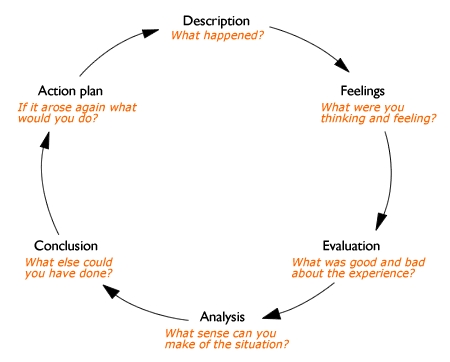
Kacperek used a reflective model in order to reflect on her personal experience. By doing so, it enabled her to methodically describe, analyse, evaluate and develop her understanding from her practical experience.
Whilst reflecting on her actions, Kacperek has also identified several problems she had come across with communication.
Ley (1988) states that interpersonal communication is key to all aspects of care. He suggests that problems associated with patients’ non-compliance could be prevented by improving communication skills.
Listening
Effective communication requires the use of many different interpersonal skills, including listening to patient’s.
Adair (1994) found that interviewing patients and listening to their experience of care gave a valuable insight which can be used to improve the quality of care.
Listening requires for the individual to understand the verbal, non-verbal and paralinguistic features of the message. To get the best result and to understand the message and build the patient/nurse relationship, is done by actively listening. This is often achieved by remaining and quiet and not interrupting the person talking, and occasionally, responding with short encouraging statements such as “yes”, “go on” etc.
In the authors point of view, it was quite difficult to remain quiet and interrupt the patient as soon as an idea came across her mind. However, due to Kacpereks’ circumstance, she was unable to use any verbal communication.
Silence
Silence combined with a relaxed approach allowed patients time and space to think.
Davidhizar and Newmangiger (1994) pointed out that many nurses feel quite uncomfortable with silence during their interaction with their patients. Which can often lead to verbal interruption.
Porritt (1990) states that silence can often cause the listener to feel anxious.
Touch
The use of touch is an effective method of responding to patient, which can have a positive effect towards patient care.
Touch can signify a level of understanding and can show empathy towards patients.
Both Journals have strong key points towards Non-Verbal communication. Both have praised and evidence have been provided with the effectiveness of the use of NVC in nursing care.
For example, In Kacperek’s article, all the experience spoken about, was relived and practice by the author itself. She has been able to research and study the theory behind it and also apply this into practice.
Both sets of key points, interlaces each other and sets some sort of framework of how to become more effective with NVC. With the evidence provided for both journals, it was clear that it was very well thought about.
Davies’ article was more theory based. Even though both showed evidence of references, I feel that Kacpereks’ article can be slightly biased. This is because the article itself is about ther own experience with nursing care. Even though the article itself is correctly referenced, as a third party reader, I feel like that contents of the article itself is biased as it focused on her own experiences. It does not quite show any limitations to Non-Verbal Communication. This could be due to the author not wanting to portray a negative image about her to the readers.
With Davies, the key point and some how “steps” to effective NVC was more straight forward than Kacperek. Even though both articles share some similar traits, I felt that Davies’ is more reader friendly and a lot more easier to understand.


 Nursing Learning Log