
During our time in the skills lab, we will be touching upon 3 clinical skills.
1) Preparing a trolley for a patient in isolation.
2) Theory of Cannulation and How to re-dress.
3) Aseptic Non-Touch Technique.
In this blog, I will be review Aseptic Non-Touch Technique (ANTT) through my own experience. I will be using Gibbs’ Reflective Cycle (1988) to evaluate my experience with the technique.
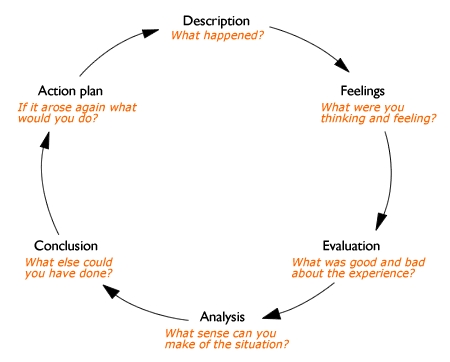
I have chosen to use Gibbs’ Reflective cycle due to its in depth step-by-step process. The cycle that Gibb’s has created enables the individual to think methodically. Each step in the cycle has it own criteria. It simplifies the situation which enables for the user to think and evaluate in more detail.

Aseptic Technique is used to prevent and minimise the risk of contamination. an example for when this technique is used could be when performing major/minor surgical procedures, dressing a deep tissue wound etc.
In the Clinical Skills session, we undergone a scenario where we have to change a wound dressing using ANTT. from previous experience, I have used the Technique in the past during placement, but not used it enough to regularly practice the skill.
So to follow the 6 steps of Gibbs’ Reflective Cycle:
Description – The we were given was to remove and re-apply a new dressing on a simulated wound using the Aseptic Non-Touch Technique. As a group, we we’re shown how to perform the task using the technique. As a group, we we’re shown how to perform the task using the technique with a set of guidelines taken from the Royal Marsden 2015.
The procedure involved the following steps:
- Explain the procedure to the patient and gaining consent.
- Perform Hand Hygiene.
- Clean Trolley.
- Gather relevant equipment.
- Perform Hand Hygiene.
- Put on Apron and NON-STERILE gloves.
- Remove current Dressing and Assess the wound.
- Remove PPE and perform Hand Hygeine.
- Open Wound Dressing pack and unravel using the corners of the sheet.
- Arrange the items using the plastic bag in the pack.
- Attach the plastic bag on the trolley. This would then be used for any clinical waste.
- Using the Clinel wipe to wipe the Saline packet before opening and pouring into the pot.
- Perform Hand hygiene and apply apron and STERILE gloves.
- Put sterile towel under and over the wound, leaving an opening to access the wound.
- Clean the wound and apply a clean dressing.
- Dispose of the clinical waste, clean the trolley and perform hand hygiene.
Feelings – Coming into the practical, I felt confident that I can perform the task well as I have had prior knowledge and experience with ANTT. During demonstration, there were certain specific tasks that was done differently than what I was originally taught. This then made me question which one is the correct technique to use. It did bring my confidence down slightly and made me question, ” Have I been doing this wrong this whole time?”.
During the practical, I did not feel as confident as I taught I did. Bear in mind that I have not performed this task for a while, I will bound to have some sort of mistake. However, I was making more mistakes than I thought I would have made. I stayed calm and carried on with the task. With the guidance from my tutor, I was able to pick up the pieces and manage to get myself back on track. And having the opportunity to perform the task a second time really help with my confidence and I was able to think of a rationale for each step of the technique.
Evaluation – an advantage for in this practicaly is that I have had experience in ANTT in the past. I have used the technique before in different scenarios and have a general knowledge towards the process.
However, in contrast, there are some minor issues that i have found whilst doing the practical. Even though I have previous experience using the technique, I do not regularly practice the skill on my current job. Another downside to this is that, as mentioned before, I have been shown different techniques to use in the past which is different to what we have been taught this time round. Even though the principal of ANTT is essentially the same, it has thrown me off with the way I was previously taught. This then led to a lack of self confidence.
Analysis – in the midst of practical, I was able to come up with a rationale to why it is neccessary to do certain steps in ANTT. It enabled me to utilise my critical thinking. The use of ANTT in tge practical session is very simple and straight forward, however in a real situation, wound care could be even more complex and ANTT is not just used to redress wounds.
 Nursing Learning Log
Great blog and use of Gibbs cycle! You outline why you used this cycle well. Have a look at other models and see if they have merits against Gibbs or not. This will help you in AE2 at the end of the unit. Thank you and well done! I am looking forward to reading your comparison of the two articles.
LikeLike